|
Making
Adirondack Chairs
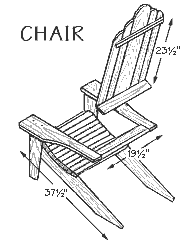 You'll
probably want to build two chairs to make a set, so duplicate steps
for the second chair when making the first. You'll
probably want to build two chairs to make a set, so duplicate steps
for the second chair when making the first.
Begin by cutting all the 1x boards (various widths) to length. Then
rip cut them to width according to your plan. To keep track of each
piece, label them with a pencil (i.e. "B" for back boards).
The back boards are called splats. Slide them together and using
a compass, mark a half circle on the boards. Our plan called for
a radius 3 1/2" from the side with a 2 15/16" radius on
each end board. Cut the outside edge of the marks with a jig saw
then sand them down smooth to the pencil mark.
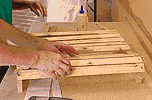 Angle
cut the front slats of the seat to wrap around the front edge. Also,
angle cut the cross piece that supports the splats in back. Saw
the rounded slat supports and assemble the seat section. Angle
cut the front slats of the seat to wrap around the front edge. Also,
angle cut the cross piece that supports the splats in back. Saw
the rounded slat supports and assemble the seat section.
Saw the armrests according to the plan's full-sized pattern. We
tacked them together and cut both armrest boards at the same time.
Next, mark the lap joints for the armrests and middle back support.
Cut them perfectly square so the ends of the armrests overlap the
ends of the support. Pre-drill, glue and fasten the armrests to
the support. We countersank the holes with a Forstner bit so we
could later plug them.
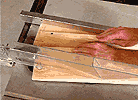 Cut
out the back legs that support the slats. These cuts are a bit tricky.
Each leg is narrow at the bottom and wide at the top, and both ends
are mitered cut. We made two chairs, so we made a jig to guide the
cuts through the saw so all the legs would be the same. Cut
out the back legs that support the slats. These cuts are a bit tricky.
Each leg is narrow at the bottom and wide at the top, and both ends
are mitered cut. We made two chairs, so we made a jig to guide the
cuts through the saw so all the legs would be the same.
Saw the front legs and the pie-shaped armrest supports. Mark and
pre-drill screw holes through the legs and seat supports. We also
used another jig to space the holes. Then fasten the legs to the
slat supports.
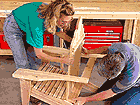 Glue
and screw the splats to their upper and lower cross member supports.
Gap the splats on the lower support and a scrap piece the same height,
then fasten the splats to the support. Flip the unit over and clamp
the upper support in place. Again, flip the unit over, gap the splats
and fasten the upper support. Glue
and screw the splats to their upper and lower cross member supports.
Gap the splats on the lower support and a scrap piece the same height,
then fasten the splats to the support. Flip the unit over and clamp
the upper support in place. Again, flip the unit over, gap the splats
and fasten the upper support.
Fasten the armrest assembly to the front legs, set the splat unit
on its support (angling the bottom in without stressing the glued
joints) and fasten them together in back.

Fabricating
An Adirondack Footstool
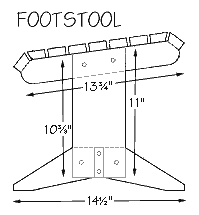 The
plan for our Adirondack footstool included an angled top that accentuated
the slope of the chairs and boomerang-shaped feet that made it a
pretty sturdy unit. Because it was fairly small and easy to handle,
we assembled the piece on a level workbench surface to help get
all the joints lined up properly. The
plan for our Adirondack footstool included an angled top that accentuated
the slope of the chairs and boomerang-shaped feet that made it a
pretty sturdy unit. Because it was fairly small and easy to handle,
we assembled the piece on a level workbench surface to help get
all the joints lined up properly.
Cut the footstool supports and legs to length and width (cut the
slats later). Label them with a pencil to keep track of where they
go.
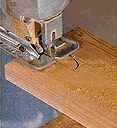 Notch
the two legs at the bottom to fit snugly over the stretcher (cross
brace). Mark out the notch according to the dimensions of the plan
and cut them out with a jigsaw. If the joints are too tight, sand
them to fit. Notch
the two legs at the bottom to fit snugly over the stretcher (cross
brace). Mark out the notch according to the dimensions of the plan
and cut them out with a jigsaw. If the joints are too tight, sand
them to fit.
Miter cut the tops of the legs 8° so the top of the rest will
slope slightly. Tap the mitered legs onto the stretcher. Attach
the boomerang-shaped feet on each leg.
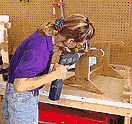 Screw
the side rails to the outside edge of each leg, making sure they're
flush with the legs' mitered tops. Once the sides are on, measure
across them to get the slat distances and cut those to length. Screw
the side rails to the outside edge of each leg, making sure they're
flush with the legs' mitered tops. Once the sides are on, measure
across them to get the slat distances and cut those to length.
Fit the slats over the rails and gap them accordingly. Pre-drill
holes in the centers, then glue and screw them in place.
Building
An Adirondack Side Table
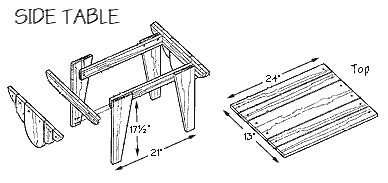
The Adirondack
table plan we had called for side and end rails holding the tabletop.
The angled legs and rounded table ends are designed just like the
features of the chair.
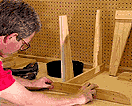 Angle
cut the legs narrow at the bottom and wide at the top. You can mark
out each board and cut along the angled lines, but we ran them through
the saw guided on a wood jig. That made all four legs identical. Angle
cut the legs narrow at the bottom and wide at the top. You can mark
out each board and cut along the angled lines, but we ran them through
the saw guided on a wood jig. That made all four legs identical.
Cut the side rails to length and width. Then glue, clamp and screw
the legs along the ends of the side rails. Use a tri-square to flush
the joints.
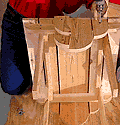 Cut
out the end rails and attach them to the legs. The ends are rounded
off and support the rounded ends of the tabletop. Cut
out the end rails and attach them to the legs. The ends are rounded
off and support the rounded ends of the tabletop.
Mark out the radius for each end splat. Cut them with a jig saw
on the outside edge of the mark and sand them down to the mark.
Set the tabletop splats, glue and fasten them in place. Our plan
called for five pieces spaced about 1/4" apart that overhang
3/4" on each side to cover the tops of the end pieces.
Plugging
& Finishing
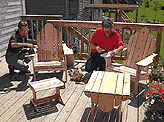 Once
the furniture is assembled, it needs to be sanded smooth and sealed
-- either by paint, stain or some clear coat finish. Yet, prior
to sanding and finishing, the countersunk screws and their holes
should be plugged to prevent water from entering the wood. The plugs
also give the furniture a professionally-built look. Once
the furniture is assembled, it needs to be sanded smooth and sealed
-- either by paint, stain or some clear coat finish. Yet, prior
to sanding and finishing, the countersunk screws and their holes
should be plugged to prevent water from entering the wood. The plugs
also give the furniture a professionally-built look.
We used a plug cutter attachment on the drill press and cut about
200 plugs from cedar stock to match our furniture. But if you're
not too concerned with matching the furniture's wood, lumber yards
and how-to centers often carry a variety of pre-cut plugs.
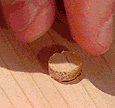 Dab
some glue on the plugs and set them in place, making sure the plug
grain lines up with the piece. Tap the plugs snugly in place. After
installing the plugs, lightly sand the entire piece. Feel across
the plugs and sand down any that stick up too high. Dab
some glue on the plugs and set them in place, making sure the plug
grain lines up with the piece. Tap the plugs snugly in place. After
installing the plugs, lightly sand the entire piece. Feel across
the plugs and sand down any that stick up too high.
Prime the furniture and paint it with an exterior enamel. Paint
is the traditional finish for this style of chair and we selected
forest green to give the whole set a resort flavor. However, you
may instead want to stain your chair after the wood has had a chance
to dry out.
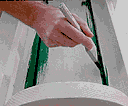 Painting
the slats can be a bit tedious, but you want good coverage between
them. Use a small brush to paint the tight spots. Also, be sure
to paint the bottoms of the legs because moisture can easily wick
into the wood if it's not protected there. Painting
the slats can be a bit tedious, but you want good coverage between
them. Use a small brush to paint the tight spots. Also, be sure
to paint the bottoms of the legs because moisture can easily wick
into the wood if it's not protected there.
plans
courtesy of: WoodWorkersWorkShop.com
|


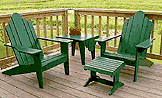 Homemade
patio furniture is an excellent weekend project to complement a
deck or patio. With a good set of instructions, a few basic power
tools, and a little know-how, the results can be outstanding.
Homemade
patio furniture is an excellent weekend project to complement a
deck or patio. With a good set of instructions, a few basic power
tools, and a little know-how, the results can be outstanding.  Also,
we decided to use cedar, but pine is also commonly used for outdoor
furniture. It weathers faster than redwood or cedar. But if you're
painting the chair, pine is also a good choice.
Also,
we decided to use cedar, but pine is also commonly used for outdoor
furniture. It weathers faster than redwood or cedar. But if you're
painting the chair, pine is also a good choice.