|
Start
With The Panels
 Since
construction-grade wood needs time to dry while you’re building,
I’ll lead you through the preparation of parts in stages. Moving
from one group of parts to another as you work allows wood to cup
and twist (as it inevitably will) while you still have the opportunity
to do something about it. Since
construction-grade wood needs time to dry while you’re building,
I’ll lead you through the preparation of parts in stages. Moving
from one group of parts to another as you work allows wood to cup
and twist (as it inevitably will) while you still have the opportunity
to do something about it.
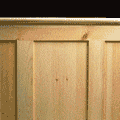
The panels are a prominent part of the bed, so choose and combine
grain patterns with care. This is where artistry comes in. Since
the finished panels are about 3/8" thick, you can easily get
two panel parts by splitting 1 1/2" lumber down the middle,
on edge. This leaves lots of extra wood for jointing and planing
operations. If you don’t have a bandsaw, rip the panel parts
no wider than 4", then slice them in half, on edge, in two
passes across your tablesaw. Splitting thick stock like this naturally
reveals striking book-matched grain patterns on matching parts.
This is good stuff, so make the most of it.
Next, spend time at the workbench arranging panel parts so they
look their best. Mark the location of neighbouring pieces, then
set them aside to dry for at least three or four days before jointing
and edge gluing. Thin, newly split pieces like these tend to cup
as they dry, so you’ll want to let that happen before jointing.
I designed the completed panels to be less than 12" wide so
they could be milled in any benchtop thickness planer after lamination.
Set the panel parts aside for now.
Bags And Bags Of Shavings
Most of the bunk bed parts are 1 1/8" thick, meaning you’ll
have to spend hours working with your planer to mill the 1 1/2"-thick
boards down to size. You’ll save time if you rough-cut all
stiles, rails, bullnose cap strips, side rail support strips, support
boards, safety rails and ladder parts to width first, instead of
running uncut lumber through your planer, and then cutting these
parts. Joint and plane components to 1/8" thicker than final
size, then let them sit for a week with a fan blowing on the stickered
pile before milling to final thickness. Keep the parts in separate
groups so you can work on each kind in turn.
Laminate The Legs
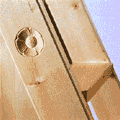
The bunk bed legs are thick and long, making them the most troublesome
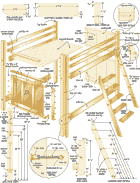
part of the project. The plans show how each leg has five parts:
three hefty internal layers, capped by two face strips that hide
the lamination lines.
Divide the 12 leg layers you cut earlier into four groups: three
pieces for each leg. The idea is to arrange the layers so the outer
face of each leg looks best. Mark relative layer locations, then
joint and plane leg layers to 1 1/4"-thick and glue them together.
A few wooden hand screws tightened across the edges of the layers
will do wonders to align the parts as the main clamps draw them
together. This saves lots of jointing later.
While the leg layers are drying, cut the leg cap strips slightly
wider than listed and plane to final 3/16" thickness. When
the legs are ready to come out of the clamps, joint and plane them
to final size. Glue the cap strips over the sides showing the lamination
lines, using as many clamps as needed for gap-free joints. Plane
the excess edging flush with the legs, sand and rout a chamfer along
all edges. The plans show how the joint line between leg and leg
cap disappears if you cut so its edge lands on the joint line.

Back To The Panels
Joint one face of each panel member, then joint an edge, before
ripping each piece to wider-than-final width and jointing this sawn
edge. Keep all panel parts grouped, as you arranged them earlier
for best appearance, while dry-fitting the panel parts. When everything
looks good, edge-glue the panels, scraping off excess glue after
a few hours when it’s half-hard.
As the panels are drying, joint and plane the rails and stiles to
final size, then trim to length. The plans show how the edges of
these parts require grooves to house the panel edges. These grooves
also admit floating hardwood tenons that join the panel frames.
This is why the panel grooves extend around the ends of the rails.
A wing-cutter router bit in a table-mounted router is the best tool
for cutting these grooves. Take one pass from each side of the rail
and stile parts so the grooves are centred. Aim for a 3/8"-
to 7/16"-wide groove, then plane and trim your floating tenons
for a snug fit.
 Dry-fit
all stiles, rails and floating tenons under clamp pressure to check
for tight joints, then measure the inside dimensions of the frame
(to the bottom of the grooves) to determine the ideal panel size.
Make the panels 1/16" smaller than these measurements and plane
the panels to fit nicely within the grooves. Dry-fit the stiles,
rails and panels, then assemble the frame permanently with glue.
Give everything a day or two to dry, then joint the outside edges
of the frame parts to level and square them. Dry-fit
all stiles, rails and floating tenons under clamp pressure to check
for tight joints, then measure the inside dimensions of the frame
(to the bottom of the grooves) to determine the ideal panel size.
Make the panels 1/16" smaller than these measurements and plane
the panels to fit nicely within the grooves. Dry-fit the stiles,
rails and panels, then assemble the frame permanently with glue.
Give everything a day or two to dry, then joint the outside edges
of the frame parts to level and square them.
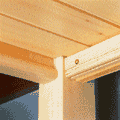
Mill the bullnose cap strips on a table-mounted router, then fasten
them to the top and bottom edges of the assembled panel frames using
3/8" fluted dowels. With all the parts of this project that
needed dowelling, I invested in a self-centering drilling jig to
help me bore accurate dowel holes in the panel edges and the ends
of the side rails—all parts too large to be bored on my drill
press. It worked wonderfully. When the cap strips are glued to the
panel frames, run the edge of the assembly over the jointer again,
taking a light cut to level the sides for a tight fit with the legs.
Install 3/8"-fluted dowels across the leg-to-panel joints,
dry-fit under clamping pressure, then join the legs and panel frames
permanently. Cleaning glue squeeze-out from the corner where the
legs meet the panel frames would be difficult without help. I used
Waxilit, a glue resist that looks like skin cream. Smear some across
the dry-fitted joints—when the joint is reassembled with glue
the product prevents the squeeze-out from bonding to the surface
wood. The hardened glue pops off with a chisel.
Refine The
Legs And Safety Rails
The plans show how each leg needs counterbored holes for the bed
bolts, and two mortises to house the safety rails for the top bunk.
Drilling the holes is easy (just don’t do it before you’ve
read further), though the mortises demand explanation. I made mine
using a router and flush-trimming bit, guided by the shop-made plywood
jig. This creates four identical round-cornered mortises in the
legs that need to be squared by hand with a chisel. Use these mortises
as a guide to plane, rip and joint the safety rails you rough-cut
earlier, so they fit into the mortises sweetly. Complete the rails
by sanding, trimming to final length and routing quirk beads on
all four edges. These extend to within 1 1/4" of the end of
each safety rail.
Side Rails, Support Strips And Support Boards
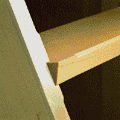 These
parts connect the head and foot boards, and support the two twin-size
mattresses that the bed is made for. Mill and trim these parts to
final size, then rout quirk beads on all four edges of the side
rails, on one edge of the support strips, and along one edge of
the support boards. The plans show the details, though you’re
free to use whatever profile you like. These
parts connect the head and foot boards, and support the two twin-size
mattresses that the bed is made for. Mill and trim these parts to
final size, then rout quirk beads on all four edges of the side
rails, on one edge of the support strips, and along one edge of
the support boards. The plans show the details, though you’re
free to use whatever profile you like.
Before you go further, think about mattress size. Although there
are supposed to be standard sizes out there, the variation from
brand to brand can be considerable. It’s safest to have your
mattresses on hand, then measure them and adjust side rail hole
locations in the legs, and the side rail lengths, to suit. The dimensions
and locations I used are for mattresses that are slightly larger
than printed mattress specs.
Drill holes in the legs and side rails for the bed bolts now, then
glue and screw the mattress support strips to the inside edge of
the side rails. If I had to build my beds over, I’d raise the
support strips 1" higher than where I put them. That’s
what’s shown in the plans. Without an exceptionally thick mattress,
the side rails press into your legs as you roll out of bed. Raising
the mattresses with the higher support strip location solves the
problem .
Final Fit And Finish
 Test-fit
the head and foot boards with the side rails using the bed bolts,
but leave the safety rails off for now. Even if the safety rails
fit easily into their mortises, they can be tight when they come
together in the completed bed. Save this wrestling match for final
assembly. I needed an 8' set of pipe clamps to draw the head and
foot boards together over the safety rails as the bed came together
after finishing. Test-fit
the head and foot boards with the side rails using the bed bolts,
but leave the safety rails off for now. Even if the safety rails
fit easily into their mortises, they can be tight when they come
together in the completed bed. Save this wrestling match for final
assembly. I needed an 8' set of pipe clamps to draw the head and
foot boards together over the safety rails as the bed came together
after finishing.
Cut, sand and rout the support boards, then test-fit them over the
support strips. The plans show how the corners of the outer support
boards need square notches to fit around the legs. You don’t
have to fasten them, they just rest loose on the support strips.
When everything looks good, take the bed apart and apply a finish.
I chose not to use stain because it highlights dents and scratches
when light, unstained wood shows through the damaged areas. And
that proved a good precaution because Joseph, my two-year old, wasn’t
in his bottom bunk more than five minutes before he sunk his teeth
savagely into the silky, hand-rubbed urethane finish I applied.
You Will Need
For the head and foot boards Size Qty.
Legs 3 1/4" x 3 5/8" x 78" 1
Leg cap strips 3/16" x 3 1/4" x 78" 8
Long panels 3/8" x 9 7/8" x 24 1/2" 6
Short panels 3/8" x 9 7/8" x 17 5/8" 6
Long top stiles 1 1/8" x 2 3/4" x 24" 4
Long bottom stiles 1 1/8" x 2 3/4" x 30 3/4" 4
Short top stiles 1 1/8" x 2 3/4" x 17" 4
Short bottom stiles 1 1/8" x 2 3/4" x 23 3/4" 4
Narrow rails 1 1/8" x 2 3/4" x 33" 4
Wide rails 1 1/8" x 4 1/4" x 33" 4
Short floating tenons—hardwood 3/8" x 1" x 2 1/4"
16
Stile floating tenons—hardwood 3/8" x 1" x 1 3/4"
16
Long floating tenons—hardwood 3/8" x 1" x 3 3/4"
16
Bullnose cap strips 1 1/8" x 2 3/8" x 38 3/8" 8
Dowels 3/8" dia. x 1 1/2" fluted 40
For
the mattress support assembly
Side rails 1 5/16" x 6 7/8" x 76 3/4" 4
Side rail support strips 1 1/8" x 1 3/4" x 76 3/4"
4
Support rail screws #14 x 2" round head, brass 24
Support boards 1 1/8" x 3 15/16" x 40 7/8" 40
Bed bolts 3/8" dia. x 5"* 8
Bed bolt caps hardwood, 1" dia. domed caps 8
For
the ladder and safety rails
Ladder sides 1 1/4" x 4 3/8" x 61 1/2" 2
Main ladder steps 1 1/8" x 5 1/8" x 16 1/2" 5
Safety rails 1 1/8" x 4 1/8" x 78 3/4" 4
Long ladder screws and cup washers #10 x 3 1/2" 2
Short ladder screws and cup washers #10 x 2 1/4" 2
Dowels 3/8" dia. x 1 1/2" fluted 2
*Includes cylindrical brass nuts, Lee Valley #05G17.01
Fine
Furniture From Cheap Wood
Where I live,
kiln-dried construction-grade 2 x 10s sell for about 70 cents per
board foot at lumberyards. That’s less than half the retail
price of furniture-grade pine, and the wood is better in some ways,
too. Construction-grade stock is cut from spruce, jack pine or fir
trees, all of which are surprisingly strong and dense for softwood.
The quality of wide construction planks can also be astonishingly
high. It’s not unusual to see a 12'-, 14'- or 16'-long 2 x
10 that’s nearly free of knots. Even planks with big ugly defects
often contain lengths of beautiful wood on each side. Spruce, in
particular, is especially striking when it’s quartersawn, revealing
closely-spaced growth rings on the visible face. Construction-grade
wood makes great furniture, as long as you choose and handle it
properly.
You’ll find about half the wood in a given lumberyard pile
is good enough for fine work. And don’t be afraid of defects
or mechanical damage on otherwise good boards. You’ll be planing
and jointing the lumber anyway, so these flaws are irrelevant. Once
you get your wood home, you’ll need to dry it to the 6% to
8% moisture content demanded for furniture use. Even though dry
construction lumber has been kiln-dried, don’t be fooled. For
construction lumber, kiln-dried means the wood has less than a 20%
moisture content. That’s enough to prevent mold growth in transit,
but it’s far from being dry enough for furniture. As you leave
the lumberyard, grab some of the thin strips of wood that separate
planks in the pile. They’ll be thrown out anyway, and they’re
perfect for separating layers of lumber as you restack them indoors,
in a heated space. This is key; you’ve got to store your wood
in fully heated, indoor conditions (preferably during bone-dry winter
conditions) or it won’t dry enough. An oscillating room fan
directed at the pile will help drop moisture content from 20% to
8% in about a month. You don’t have to wait that long to begin
cutting, just be sure the wood is that dry before final jointing,
planing and assembly.
plans
courtesy of: WoodWorkersWorkShop.com
|


 People
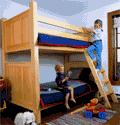
who see the bed are surprised to learn it’s made almost entirely
from construction-grade 2 x 10s. There’s beautiful wood bound
for use in house frames, and you’ll save money by redirecting
the best of it into your workshop, air drying it and turning it
into furniture. The cost of doing business with this under-appreciated
material is access to a jointer, thickness planer and tablesaw.
You can’t build this project without these machines, so don’t
even try. For more on selecting and drying construction-grade wood,
see the sidebar “Fine Furniture From Cheap Wood” here.
People
who see the bed are surprised to learn it’s made almost entirely
from construction-grade 2 x 10s. There’s beautiful wood bound
for use in house frames, and you’ll save money by redirecting
the best of it into your workshop, air drying it and turning it
into furniture. The cost of doing business with this under-appreciated
material is access to a jointer, thickness planer and tablesaw.
You can’t build this project without these machines, so don’t
even try. For more on selecting and drying construction-grade wood,
see the sidebar “Fine Furniture From Cheap Wood” here.