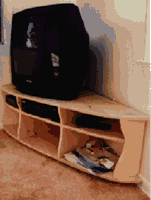
|
Construction
Wood Required
(Pine):
| Description |
Qty |
Depth |
Width |
Length |
| Top |
1 |
3/4" |
26" |
48" |
| Base |
1 |
3/4" |
26" |
48" |
| Middle |
1 |
3/4" |
26" |
48" |
| Left end
support |
1 |
3/4" |
26" |
13 1/4" |
| Middle
supports |
2 |
3/4" |
26" |
13 1/4" |
| Right support |
1 |
3/4" |
12" |
13 1/4" |
| Feet |
4 |
large wooden,
rounded door knobs |
|
Note: to create
the widths needed for the top, middle and base pieces, you will
need to glue and dowel two pieces of pine together.
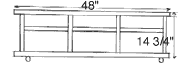 Using
the diagram as a (very) rough template, sketch out the final shape
of the top on the 48" x 26" piece of wood. To give a basic
idea of the size, remember the above dimensions for the left and
right supports, and note in the diagram that the top piece curves
sharply close to its right end, just past the final support. Once
you are satisfied with the shape of the top, use a jigsaw to cut
out the shape, and then sand down the edge to a smooth finish. Once
the top is cut to a smooth shape, use it as the template for cutting
out the base piece, which is exactly the same size and shape. Using
the diagram as a (very) rough template, sketch out the final shape
of the top on the 48" x 26" piece of wood. To give a basic
idea of the size, remember the above dimensions for the left and
right supports, and note in the diagram that the top piece curves
sharply close to its right end, just past the final support. Once
you are satisfied with the shape of the top, use a jigsaw to cut
out the shape, and then sand down the edge to a smooth finish. Once
the top is cut to a smooth shape, use it as the template for cutting
out the base piece, which is exactly the same size and shape.
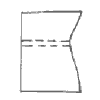
The middle piece
should be indented one inch when compared to the top and the bottom.
To do this, use the top piece as the template and draw the size
of another (equally large) piece on the wood allocated for the middle.
Then, draw a new line on the middle piece that is indented one inch
from this first "top" line. The resulting inner line is
the correct size of the middle piece and this too can now be cut
and sanded to shape.
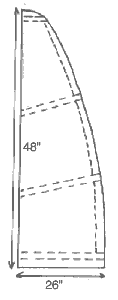
Next, the four
support pieces should by cut to shape. The prerequisites for the
shape of these are that they should be flush with the front edge
of the top and bottom pieces, as well as with the smaller middle
piece. Because of this, the final shape of the supports becomes
a curved shape as shown in the diagram (see left). The depth of
these supports varies, depending upon which support it is. The right
and left support depths is relatively easy to gauge as it is a perpendicular
line drawn from the back of the unit, 1 1/2" in from each side.
The middle two supports, however, are perpendicular to the front,
curved angle at the point at which the curve meets the support (see
top diagram). It is therefore necessary to calculate where these
middle two supports must be positioned before their depth can be
agreed upon.
 The
position of the middle two supports should obviously straddle the
central point of the center (so that the unit looks balanced). To
determine how large a gap should be allowed between these two supports
is determined by the width of your particular VCR. Measure the width
of your VCR and add at least one inch to this dimension (2"
would be preferable) to allow free circulation around the machine.
Use this dimension to decide where the two supports should be located
(measure at the front of the unit) and then project back a perpendicular
line from this point until it reaches the back of the unit. You
can now cut the supports to this depth. The
position of the middle two supports should obviously straddle the
central point of the center (so that the unit looks balanced). To
determine how large a gap should be allowed between these two supports
is determined by the width of your particular VCR. Measure the width
of your VCR and add at least one inch to this dimension (2"
would be preferable) to allow free circulation around the machine.
Use this dimension to decide where the two supports should be located
(measure at the front of the unit) and then project back a perpendicular
line from this point until it reaches the back of the unit. You
can now cut the supports to this depth.
Once all four
supports have been cut to shape, they can be screwed and glued to
the base of the unit. Having done this, the middle board should
then be cut into three pieces; one for each of the gaps between
the supports. Once cut to shape, they can be glued at an appropriate
height to form the VCR/cable TV shelf. To determine the correct
height for this shelf, measure the height of the VCR and the cable
box. Add a minimum of 1" to the height of the tallest device
and use this as the height of the shelf. Note that all three middle
shelf units should be attached at the same height. To attach the
middle shelf units to the supports, a combination of screwing and
gluing can be used as follows. Firstly, glue and screw the central
middle shelf into place. It is important to do this shelf first
as starting at either end can bring a greater inaccuracy into the
measurements. Furthermore, this is the shelf that will take the
most weight and should therefore be screwed at both sides. Next,
attach the left-hand-side middle shelf. To do this, screw and glue
though the left support and simply glue onto the middle support.
It is preferable to also use a couple of dowels into this middle
support, as this will make the unit much stronger. Clamp this shelf
in place overnight to ensure that the glue bonds sufficiently. The
next day, repeat this exercise for the right-hand shelf.
 Once
all the glued joints are dry, the clamps can be removed and the
top piece added. Do not use screws to hold this in place as we wish
to keep the top of the unit "pure". Instead, just glue
and clamp. Once the glue has bonded, the unit can be give n a final
sanding and may then be waxed. Waxing is preferable to varnish on
a project such as this for a number of reasons. Firstly, most furniture
polish helps to improve the shellac overtime; the wax helps the
wood to age more naturally over time; most importantly, a unit such
as this is likely to get scratch (TVs get moved and so on): it will
be easier to sand and re-wax scratches than it would be the sand
and try and match the varnish (and, of course, varnish takes far
longer to dry!) Once
all the glued joints are dry, the clamps can be removed and the
top piece added. Do not use screws to hold this in place as we wish
to keep the top of the unit "pure". Instead, just glue
and clamp. Once the glue has bonded, the unit can be give n a final
sanding and may then be waxed. Waxing is preferable to varnish on
a project such as this for a number of reasons. Firstly, most furniture
polish helps to improve the shellac overtime; the wax helps the
wood to age more naturally over time; most importantly, a unit such
as this is likely to get scratch (TVs get moved and so on): it will
be easier to sand and re-wax scratches than it would be the sand
and try and match the varnish (and, of course, varnish takes far
longer to dry!)
plans
courtesy of: WoodWorkersWorkShop.com
|